
Dynelectro Core Technology – AC:DC
Dynelectro’s AC:DC technology is a dynamic operation method for Solid Oxide Electrolysis (SOEC) that addresses the main challenges for Solid Oxide Electrolysers to become commercial – with AC:DC operation, cell degradation & contamination is reduced 5x, and temperature-gradient induced thermal stress is eliminated through temperature decoupling. Multiple research studies at universities like DTU and AU has since 2019 confirmed that AC:DC plays an important role in extending cell & stack lifetime during both steady-state and dynamic SOEC operation.
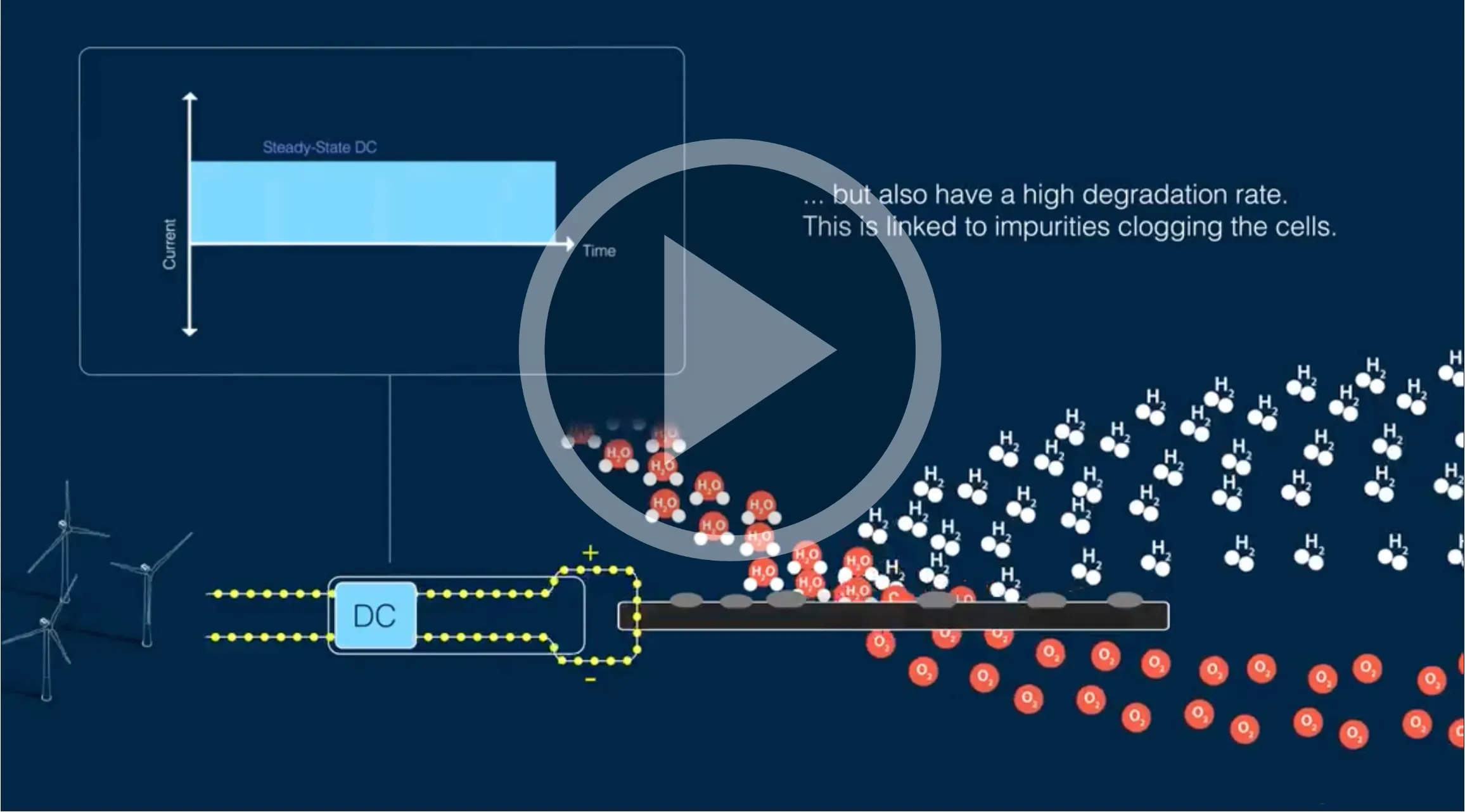
Video showing how AC:DC mitigates impurity contamination and extends cell lifetime
AC:DC – A fundamental change to the way the core of an SOEC electrolyser is operated
Dynelectro’s AC:DC technology is an operating method for Solid Oxide Electrolysis (SOEC) that rapidly switches power between standard electrolysis and brief pulses in fuel cell mode.
- SOEC – Best-in-class conversion of Power-to-Hydrogen – SOEC is recognised for best-in-class conversion of power-to-hydrogen enabling up to 90% system-level electrical efficiency when integrated with geothermal or industrial waste heat. AC:DC operation has a positive effect on stack lifetime and flexibility without affecting hydrogen production and process efficiency while
- AC:DC – Ultra-low cell degradation – Through increased impurity tolerance and reduced nickel migration, overall cell degradation is reduced by a factor of 5, extending typical SOEC cell lifetime from 2 to 10+ years . As a result, production stays high while maintenance costs are dramatically reduced.
- AC:DC – reduced cell & stack thermal stress – Solid Oxide electrolysis consumes heat, leading to a temperature gradient across the stack with lower outlet-than-inlet temperature. This equals thermal stress and high sensitivity towards process changes. With AC:DC, a bit of heat is generated inside the stack, and it is possible to control how much heat that is generated dynamically. Full temperature decoupling during load changes has been documented in a Shell GameChanger project completed 2024.
- AC:DC – Flexible hydrogen production – AC:DC operation decouples stack temperature from system load, enabling real-time load-following of variable renewable energy, downstream processes. Production can be done at any level from 0 to 100% load.
- AC:DC – Grid stabilisation – Fast load-switching is ideal for ancillary grid stabilisation services as an additional revenue stream, and AC:DC ensures system can stay in idle mode or even switch into “reverse operation” (Gas-to-Power) without a penalty to stack lifetime.
The initial AC:DC project done together with DTU Energy resulted in a patent in 2019 related to the AC:DC operational method, that has been fully acquired by Dynelectro ApS. The project was followed by projects together with Aalborg University to design advanced power converters specifically engineered to handle bi-directional, dynamic AC:DC power requirements. Also here, the resulting IP has been patented and is today owned fully by Dynelectro ApS.
By extending the life of expensive electrolyser stacks we enable commercialisation of SOEC which consumes significantly less electricity per kilogram of gas produced – up to 90% of electricity are converted into hydrogen when heat integration is implemented.
An SOEC electrolyser with AC:DC operation has extended stack lifetime, drastically lower stack expenditures and overall enables a 20% reduction in the Levelized Cost of Hydrogen (LCOH), compared to all other known electrolyser technologies. Importance of AC:DC for cost-effective eSAF production has been verified by an independent report by KBR (2026)
Verification pf ultra-low SOEC degradation completed
The AC:DC technology has been thoroughly tested in several projects. In 2025 a 25.000 hour continous AC:DC test on a SolydEra G8 stack operated was concluded. Subsequent nvestigations has confirmed a very low stack degradation of less than 0.1% per 1000 operating hours – this is a factor 5 better than the 2030 KPI set forth in EU’s Key Performance Indicators for SOEC. The succes of the test led to stack manufacturer SolydEra recommending AC:DC for extension of stack lifetime when operating in SOEC mode and results have been presented at international technology conferences.
Today Dynelectro is one of the few SOEC electrolyser OEMs having multiple SOEC units in operation and we have passed more than 100.000 hours of combined AC:DC stack operation, making it one of the most derisked stack technologies available – both lab-tests and actual deployed electrolysers all confirms AC:DC’s ability to reduce degradation and extend stack lifetime.
Stack agnostic technology – supporting both steam and co-electrolysis
The technology has been applied to SOEC & SOFC cells and stacks from multiple vendors and is confirmed vendor agnostic.
The original project concluded effect was positive both in Steam-electrolysis and CO2-electrolysis mode, and AC:DC is confirmed to reduce particle contamination in both operating modes.
In 2026 we followed this up with articles related to both modelling and experimental studies on co-electrolysis mode where performance improvements are also seen
The initial AC:DC project – collaboration with DTU Energy
AC:DC was the original project code-name for a project where Dynelectro and DTU Energy looked into the development of a control method for high-temperature electrolysis cell systems to reduce hydrogen production cost.
In the project solid oxide electrolysis cells (SOECs) were tested with a new operation method called AC:DC. The operation method decrease the degradation rate for SOECs. In the graph below AC:DC operation was used on SOEC cells from DTU Energy to conduct steam electrolysis. With AC:DC operation the cell resistance was constant after a 50 hour initiation period. In contrast, for conventional operation, the resistance increase with time.
AC:DC operation was also conducted with CO2 electrolysis for 600 hours. Here AC:DC operation was shown to reduce the degradation rate from 39 mΩcm2 per 1,000 hour to 5 mΩcm2 per 1,000 hour and to increase the impurity tolerance.
Microscopy data suggests the stable resistance with AC:DC operation is related to a removal of Nickel migration, which limits the lifetime of conventional operated SOECs, as well as reduced carbon & silica deposits – this and other results are available in this article from Journal of Power Sources (2022)
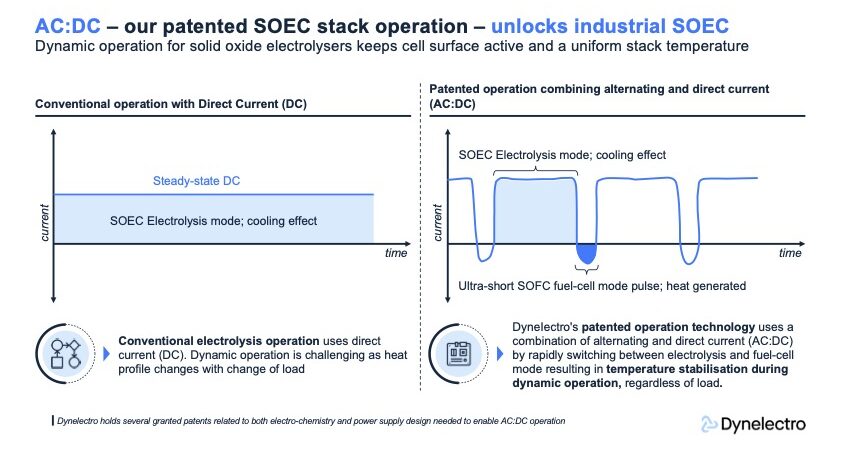
The initial project was completed in 2019 under the Teknologisamarbejde i Region Sjælland “DTU Risø Reaktor” (case no. RFS-17-0012) and has been followed up by multiple research projects and articles.
The AC:DC operation method is patented by Dynelectro ApS. Further info about the AC:DC operation method can be found in the published patent application.